The Idea-to-Concept Method can be used by individuals and groups of any size to bring a raw idea across threshold from the realm of thought to the realm of the discussable, where the idea becomes a raw concept and ready for further elaboration.A thought in your head is real as an experience. A draft in a folder is real as an artifact. A feeling is real as a feeling. But if it has not been externalized into a form that another observer can actually encounter, then it is not yet real between observers. It has not yet entered the space where the world pushes back and the world will push back.
Timothy Solomon, The Boundary Between Private and Shared Reality
Some will recognise its similarity to the 1-2-4-All method that forms part of the Liberating Structures collection. I discovered it in the early 1990s, some 10 years before Liberating Structures came into being, using it extensively in my consulting work.
The originator of the vanilla 1-2-4-All method is unknown but it could be Kathie Dannemiller, Paul Tolchinsky or Robert ‘Jake’ Jacobs as it has been widely deployed by Whole-Scale® Change and Real Time Strategic Change practitioners.
Output
A single concept is sought.
Requirements
- One facilitator.
- Minimum of four participants who have just completed Readiness work, setting their Greatcreator project in motion
- Maximum diversity among participant body.
- A suitable venue.
Method
For the purposes of this explainer, we will work on the basis that there are 16 participants and four tables, each accommodating four participants.
If necessary, this can be increased to eight per table with the two groups of four working independently before pooling their outputs. In such cases, a volunteer spokesperson speaks on behalf of both groups, thereby halving the number of report-outs
Each participant is provided with one or more (depending on the detailed process adopted) Idea-to-Concept Worksheets.
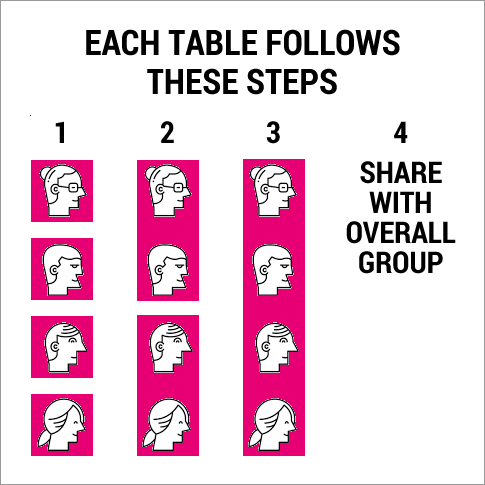
Step 1
Working alone and inspired by their earlier Readiness work, participants conceive an idea and record it on an Idea-to-Concept Worksheet similar to the one appearing below. The idea is now on its way to becoming a rudimentary concept.
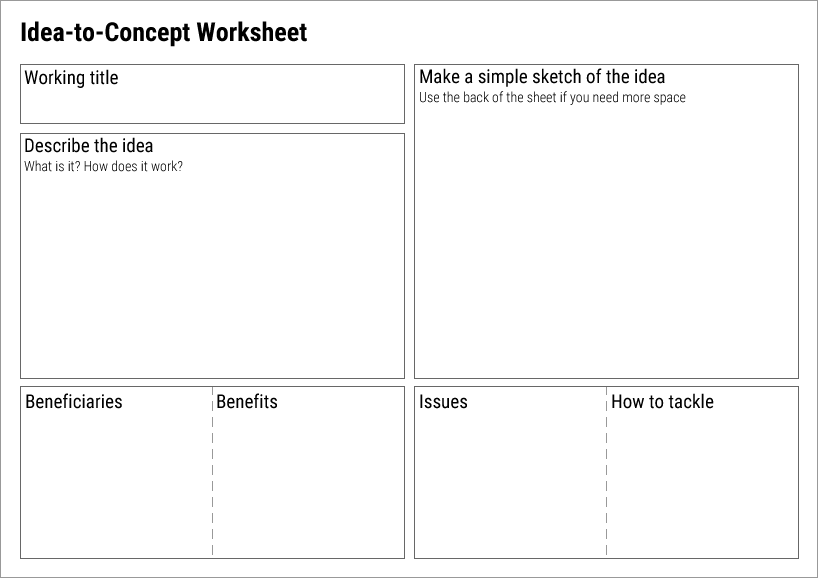
Download Idea-to-Concept Worksheet (pdf)
Step 2
People form pairs. They take it in turns to explain their idea, with the other person asking questions of clarification. The pairs discuss potential benefits and associated beneficiaries, air any immediately apparent issues (flaws, gaps, obstacles etc.) and suggest ways in which these might be tackled.
The two rudimentary concepts are merged. If one is considered superior (more potent and more fitting), the other is set aside and retained for Step 6.
Step 3
The two pairs come together. Each pair presents their merged concept to the other pair. The two concepts are then merged, or one is set aside.
Step 4
A volunteer spokesperson presents their table’s concept to the overall group.
Step 5
The facilitator works with the 16 participants to merge the four concepts (one per table) into a single concept that is both potent and fitting.
Step 6
Any concepts set aside at the end of Step 2 are reviewed, ideally in the large group, and reassessed for potency and fit.
Any concept deemed a contender is combined with the one that emerged during Step 5. When such a merger is not possible, the concept taken forward is the one displaying both the greatest value generation potential and the best fit with the design specification.
Voting is not used.
If sufficient time has been allowed, conversations about desirability, feasibility and viability can begin.
How to form the small groups
Ask participants to form groups of four, choosing people they don’t already know.
Unless the total number of participants is divisible by four, there will be one, two or three people remaining.
If three people remain, they form a group of three.
If two people remain, each joins a group of four.
If one person remains, he or she joins a group of four.
Repeat this procedure for each round.
Why this method is preferable to brainstorming and its derivatives
- It recognises that an idea is conceived in the imagination of an individual, not in some fanciful group mind.
- Natural imagining and synthetic imagination are integrated.
- All three Greatcreator action modes — creating alone, creating together and helping others create —are put to work.
- The Idea-to-Concept Worksheet enables the intangible idea to be made more tangible and makes the idea discussable. This shift from the realm of thought to the realm of the discussable follows a shift of attention from the third eye (between and just above the eyebrows) to the throat.
- Ideas are discussed and enhanced, and ways of addressing shortcomings are explored. In this way, the raw idea starts to become a fully formed concept.
- The Max4 Principle (four is the maximum group size for a proper conversation) is observed.
- The needs of introverts, autistic people, other neurodivergent members of society and the socially anxious are accommodated.
- A single concept emerges: one that is potent and a good fit.
Our species is the only creative species, and it has only one creative instrument, the individual mind and spirit of man. Nothing was ever created by two men. […] Once the miracle of creation has taken place, the group can build and extend it, but the group never invents anything. The preciousness lies in the lonely mind of a man.
John Steinbeck, cited by Roger S Bacon in The Myth of the Myth of the Lone Genius
Read more
Examine a typical Greatcreator project from start to finish
How to advance from design thinker to greatcreator
How to form small groups for fruitful conversations
The embodied Greatcreator model | Download slideshow
Search the site
Not case sensitive. Do not to hit return.