Now-to-New defined
Now-to-New (initial capitals, hyphenated) refers to a shift from the current situation (Now) to what’s needed instead (New). There are seven kinds of Greatcreator work, which are are neither mutually exclusive nor collectively exhaustive: creating, changing, problem solving, surmounting, responding, developing, and realising value generation potential.
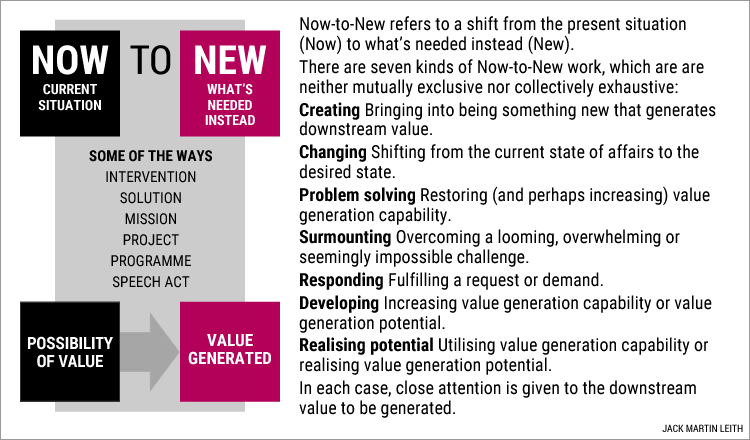
How the term came into being
In 1991 or 1992, I took part in a Neuro Linguistic Programming practitioner training led by Ian McDermott, the founder of International Teaching Seminars. Among the many concepts and strategies he taught was the TOTE (Test–Operate–Test–Exit) model depicted below.
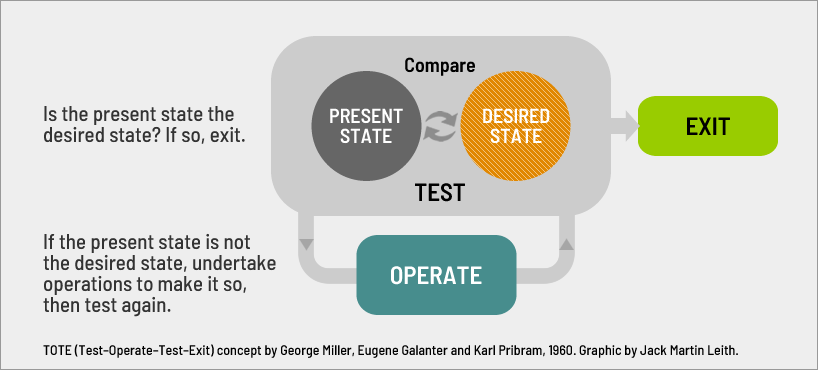
Read about George A. Miller and TOTE
The same principle is found in the field of cybernetics, the origin of which predates that of TOTE:
I participated in the NLP practitioner training while making the transition from the world of advertising and marketing to the worlds of innovation and organisational change. At the time, innovation and change were barely related and each had its own theories, its own language, its own practices and practitioners. The field of change management was in its infancy — Daryl Conner’s groundbreaking book Managing at the speed of change first saw the light of day in 1993 — and organisational change work was in the hands of organisation development (OD) people.The field is named after an example of circular causal feedback—that of steering a ship (the ancient Greek κυβερνήτης {kybernḗtēs} means “helmsperson”). In steering a ship, the helmsperson adjusts their steering in continual response to the effect it is observed as having, forming a feedback loop through which a steady course can be maintained in a changing environment, responding to disturbances from cross winds and tide.
Source: Wikipedia — Cybernetics
In the early 1990s there was much talk in the OD world about change being a journey from current reality to a desired future — a cumbersome and not wholly accurate description, given that change is not a journey (this is just a metaphor) and that what really needs to be created is a desired present. Whether at work or in their personal lives, people want what they want now, not in some hypothetical future that never arrives.
Around the same time, I stumbled upon a copy of an in-house publication produced by Gemini Consulting, a high profile and influential change management firm that evolved into CapGemini. The authors of the publication didn’t talk about current reality and desired future. Instead, they used the punchier As-Is and To-Be. Today, these terms are widely used and unremarkable, but this was not the case in 1992.
What happened next was more like a thought experiment than a deliberate attempt at creating a new term. I wondered if As-Is and To-Be could each be reduced to three letters. My first attempt yielded Got and Want: accurate labels, but a little too colloquial for the business world and still four letters in the second word. Then inspiration struck. Got became Now, Want became New, and Now-to-New came into being.
How the Now-to-New project model evolved into the Greatcreator project map
All models are representations of reality
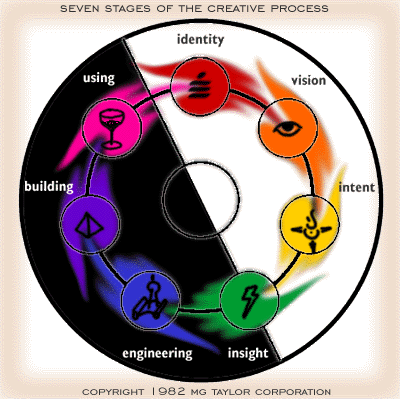
There is only one stage in the true model of the Creative Process. At the simplest level, creativity is the act of being and doing folded into a state of flow called life. I claim that we naturally spend all of our time in a state of flow, despite claims in the popular press to the contrary. Even when we’re analyzing a problem (in the Identity stage – see MG Taylor’s seven stage model below), we’re DOING something (in the Building stage), and employing tools of some sort (in the Using stage). We simultaneously embrace a rapidly evolving picture of what we want to do that unfolds just before we do it (in the Vision stage). See, it all folds together into one. What the popular press describes as a state of flow occurs when the execution of the creative process becomes jubilant, and consequently high performance.
This model resembles the greatcreator’s embodied model in certain ways. The white section corresponds with possibility and the body above the heart. The black section corresponds with actuality and the body below the heart. MG Taylor sees insight linking the two, whereas I see love in this role.
We divide the Creative Process into pieces in an effort to understand and picture the complexity of the entire process. But let’s not fall into the trap of believing that we actually execute the pieces in some sort of lock step fashion. It’s convenient and instructive to perceive that creativity has certain stages, and that we can all emotionally, physically and mentally relate to these stages, but to hold any model of the creative process as a precise description of creativity, and to force others to adhere strictly to its application is foolish.Stuart Kauffman uses an expression to describe the difficulty of modeling any living system: “the algorithm is incompressible.” In other words, there’s no shorter method, routine or program to describe life or living systems than life or the living system itself. Models are representations of reality but they are not the reality itself. There is no algorithm or equation that we can force creativity into that is shorter than the creative act itself.
Bryan Coffman when at MG Taylor Corporation, referring to stages in the MG Taylor DesignShop process | View source
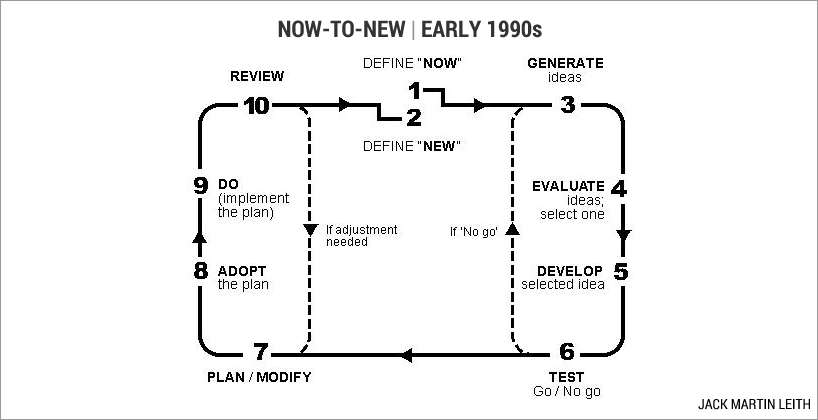
Version 1 – Now-to-New project model – 1990s
This model is not as linear as it may appear. At every stage, each of the other stages is given careful consideration. Matters of adoptability and implementation are considered when evaluating ideas, and Now is compared with New throughout. Generally, New remains constant while Now evolves, although New is always open to revision.
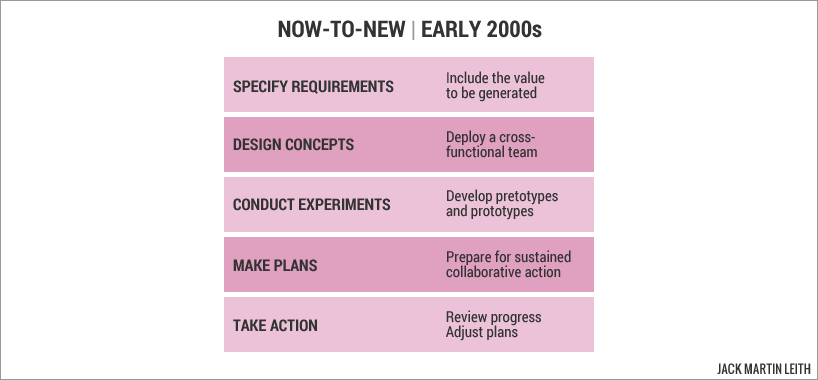
Version 2 – Creativator – early 2000s
In this and subsequent versions the emphasis is on generating maximum value for customers or users and other beneficiaries. There is considerable but unintended overlap with the generic design thinking framework:
- Specify Requirements corresponds with the design thinking phases Empathise and Define
- Design Concepts corresponds with Ideation
- Conduct Experiments corresponds with Prototype and Test
- Make Plans corresponds with Implement
- Take Action corresponds with Implement
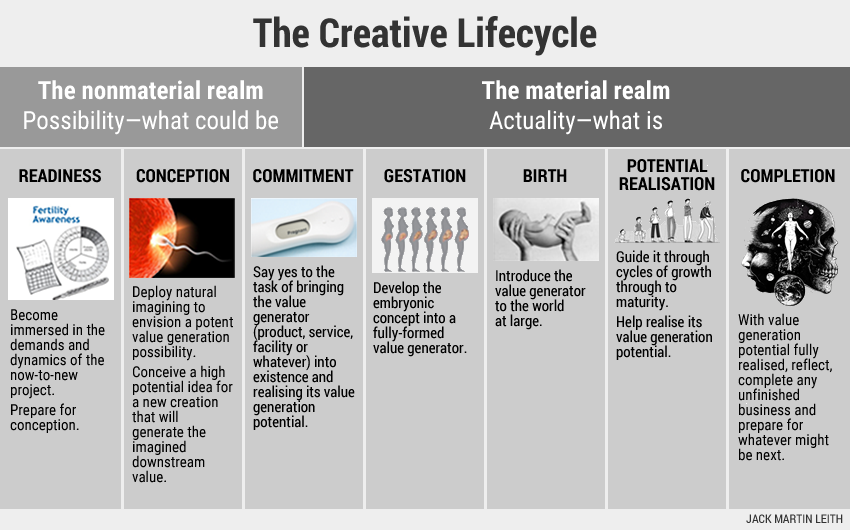
Version 3 – Creative Lifecycle – 2010s
The Creative Lifecycle is analogous to human procreation, development and maturity.
Readiness – preparing for the moment of conception – makes its first appearance. I referred to it as Groundwork until this version.
Version 4 – embodied model – 2025
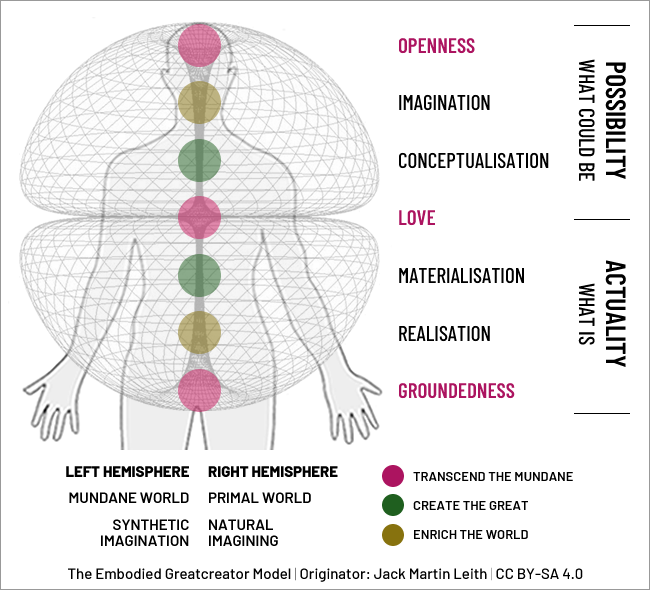
Dual torus image sourced from Michael C Grasso (explore further) and decoloured
Faith (the secular kind) is a precondition for awakening the superpower Transcend the Mundane, which in turn activates the superpowers Create the Great and Enrich the World.
Read about the imperative of faith and believing without believing
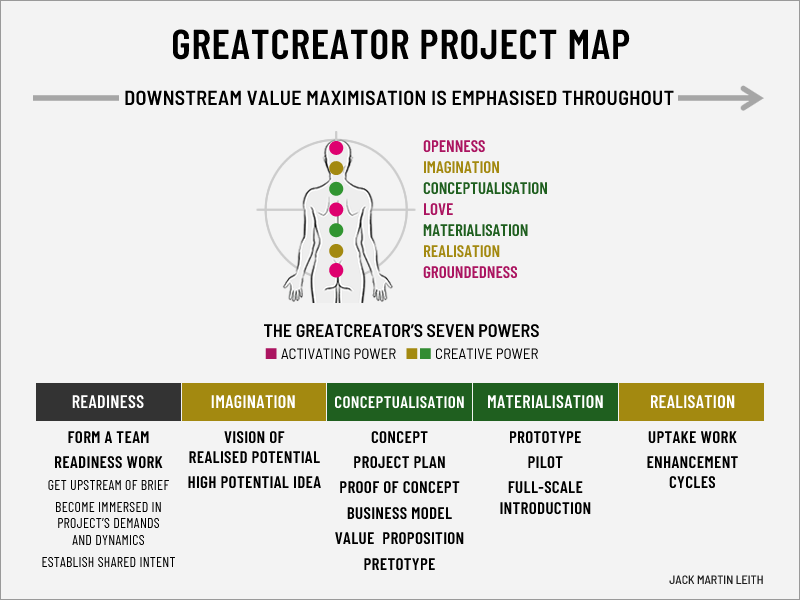
Version 5 – Greatcreator project map – 2026
Conceptual and embodied models are now fully integrated.
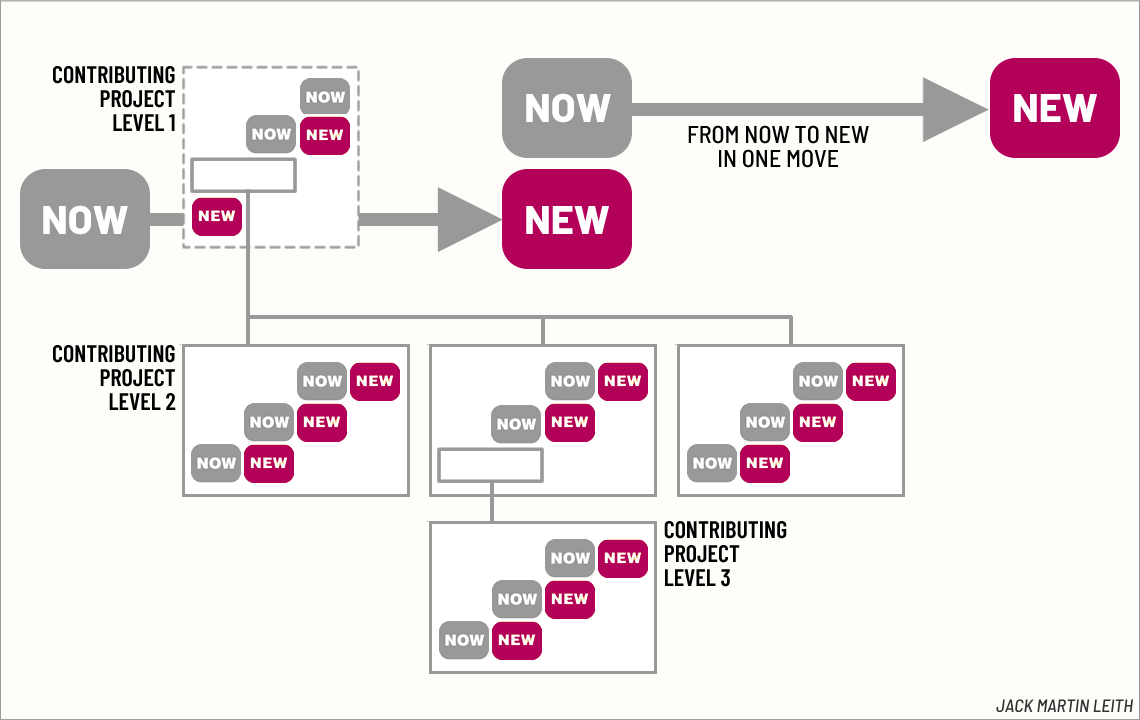
The holonic nature of the Now-to-New perspective
A holon is something that is simultaneously a whole in and of itself, as well as a part of a larger whole. In this way, a holon can be considered a subsystem within a larger hierarchical system (Wikipedia). The term was coined by Arthur Koestler.
The diagram below illustrates the linear and holonic forms of Greatcreator work and shows how each successive New becomes a new Now.
Read more
Some open source and proprietary Now-to-New methods
Search the site
Not case sensitive. Do not to hit return.